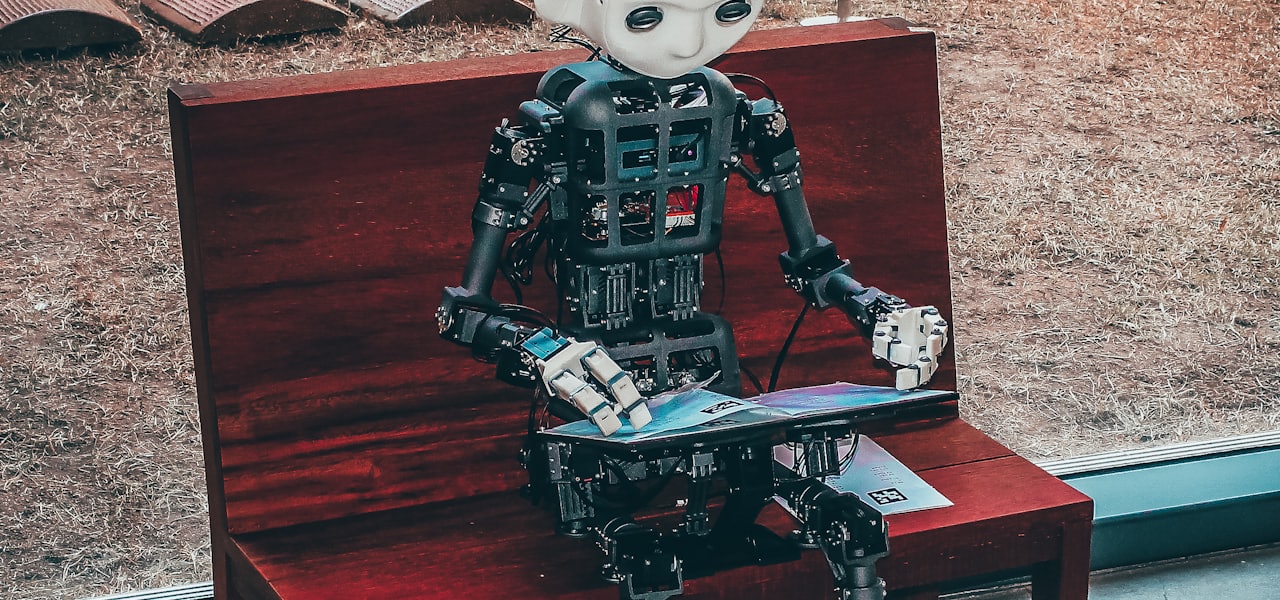
Trying to pick the best AI resume builder? An AI resume builder is software that uses machine learning to help you get more done — it scales effortlessly from a single task to thousands. The best picks balance beginner-friendly simplicity with the depth power users need, and they ship updates often. Whether you are a beginner or a pro, the right AI resume builder slots into your workflow and pays for itself fast. This guide breaks down the top picks, their pros and cons, and who each one is best for.
Butler in a Box
Butler in a Box was an early voice-controlled home automation device developed in 1983 by magician Gus Searcy and programmer Franz Kavan. The device allowed users to control various home electronics, such as lights and phones, using voice commands. It predated modern smart speakers and virtual assistants by several decades. == History == The idea for the Butler in a Box originated in 1983 when Searcy was asked by friends why he couldn't simply command lights to turn on and off if he could pull rabbits out of hats, given his background as a professional magician. Searcy partnered with former IBM programmer Kavan to develop the device, with their first prototype being named "Sidney". The Butler in a Box combined remote control technology with voice recognition to enable control of home devices. However, it faced challenges due to the technological limitations of the era and its high price point of nearly $1,500 (equivalent to around $3,700 in 2021). == Features and functionality == Users could activate the Butler in a Box by speaking a wake word, typically a traditional butler name, and the device would address the user as "boss". It was capable of performing tasks such as: Turning lights on and off, controlling individual zones if lights were connected to remote control modules Making and receiving phone calls Setting timers Pairing with sensors to function as a security alarm system However, the device required extensive voice training for each user, a time-consuming process compared to modern voice recognition. Additionally, settings and trained commands would be lost if power was out for over 3 hours due to the volatile memory technology used at the time. == Reception and legacy == While innovative for its time, the Butler in a Box did not achieve widespread commercial success due to its high price and the technical limitations of the 1980s. Nevertheless, it served as an important early step in the development of home automation and showcased the potential for voice-controlled technology to enhance accessibility and convenience in the home. Decades later, products like Amazon Alexa, Google Home, and Apple's Siri would make voice-controlled smart home devices commonplace and affordable, building on the groundwork laid by early attempts like the Butler in a Box.
FastICA
FastICA is an efficient and popular algorithm for independent component analysis invented by Aapo Hyvärinen at Helsinki University of Technology. Like most ICA algorithms, FastICA seeks an orthogonal rotation of prewhitened data, through a fixed-point iteration scheme, that maximizes a measure of non-Gaussianity of the rotated components. Non-gaussianity serves as a proxy for statistical independence, which is a very strong condition and requires infinite data to verify. FastICA can also be alternatively derived as an approximative Newton iteration. == Algorithm == === Prewhitening the data === Let the X := ( x i j ) ∈ R N × M {\displaystyle \mathbf {X} :=(x_{ij})\in \mathbb {R} ^{N\times M}} denote the input data matrix, M {\displaystyle M} the number of columns corresponding with the number of samples of mixed signals and N {\displaystyle N} the number of rows corresponding with the number of independent source signals. The input data matrix X {\displaystyle \mathbf {X} } must be prewhitened, or centered and whitened, before applying the FastICA algorithm to it. Centering the data entails demeaning each component of the input data X {\displaystyle \mathbf {X} } , that is, for each i = 1 , … , N {\displaystyle i=1,\ldots ,N} and j = 1 , … , M {\displaystyle j=1,\ldots ,M} . After centering, each row of X {\displaystyle \mathbf {X} } has an expected value of 0 {\displaystyle 0} . Whitening the data requires a linear transformation L : R N × M → R N × M {\displaystyle \mathbf {L} :\mathbb {R} ^{N\times M}\to \mathbb {R} ^{N\times M}} of the centered data so that the components of L ( X ) {\displaystyle \mathbf {L} (\mathbf {X} )} are uncorrelated and have variance one. More precisely, if X {\displaystyle \mathbf {X} } is a centered data matrix, the covariance of L x := L ( X ) {\displaystyle \mathbf {L} _{\mathbf {x} }:=\mathbf {L} (\mathbf {X} )} is the ( N × N ) {\displaystyle (N\times N)} -dimensional identity matrix, that is, A common method for whitening is by performing an eigenvalue decomposition on the covariance matrix of the centered data X {\displaystyle \mathbf {X} } , E { X X T } = E D E T {\displaystyle E\left\{\mathbf {X} \mathbf {X} ^{T}\right\}=\mathbf {E} \mathbf {D} \mathbf {E} ^{T}} , where E {\displaystyle \mathbf {E} } is the matrix of eigenvectors and D {\displaystyle \mathbf {D} } is the diagonal matrix of eigenvalues. The whitened data matrix is defined thus by === Single component extraction === The iterative algorithm finds the direction for the weight vector w ∈ R N {\displaystyle \mathbf {w} \in \mathbb {R} ^{N}} that maximizes a measure of non-Gaussianity of the projection w T X {\displaystyle \mathbf {w} ^{T}\mathbf {X} } , with X ∈ R N × M {\displaystyle \mathbf {X} \in \mathbb {R} ^{N\times M}} denoting a prewhitened data matrix as described above. Note that w {\displaystyle \mathbf {w} } is a column vector. To measure non-Gaussianity, FastICA relies on a nonquadratic nonlinear function f ( u ) {\displaystyle f(u)} , its first derivative g ( u ) {\displaystyle g(u)} , and its second derivative g ′ ( u ) {\displaystyle g^{\prime }(u)} . Hyvärinen states that the functions are useful for general purposes, while may be highly robust. The steps for extracting the weight vector w {\displaystyle \mathbf {w} } for single component in FastICA are the following: Randomize the initial weight vector w {\displaystyle \mathbf {w} } Let w + ← E { X g ( w T X ) T } − E { g ′ ( w T X ) } w {\displaystyle \mathbf {w} ^{+}\leftarrow E\left\{\mathbf {X} g(\mathbf {w} ^{T}\mathbf {X} )^{T}\right\}-E\left\{g'(\mathbf {w} ^{T}\mathbf {X} )\right\}\mathbf {w} } , where E { . . . } {\displaystyle E\left\{...\right\}} means averaging over all column-vectors of matrix X {\displaystyle \mathbf {X} } Let w ← w + / ‖ w + ‖ {\displaystyle \mathbf {w} \leftarrow \mathbf {w} ^{+}/\|\mathbf {w} ^{+}\|} If not converged, go back to 2 === Multiple component extraction === The single unit iterative algorithm estimates only one weight vector which extracts a single component. Estimating additional components that are mutually "independent" requires repeating the algorithm to obtain linearly independent projection vectors - note that the notion of independence here refers to maximizing non-Gaussianity in the estimated components. Hyvärinen provides several ways of extracting multiple components with the simplest being the following. Here, 1 M {\displaystyle \mathbf {1_{M}} } is a column vector of 1's of dimension M {\displaystyle M} . Algorithm FastICA Input: C {\displaystyle C} Number of desired components Input: X ∈ R N × M {\displaystyle \mathbf {X} \in \mathbb {R} ^{N\times M}} Prewhitened matrix, where each column represents an N {\displaystyle N} -dimensional sample, where C <= N {\displaystyle C<=N} Output: W ∈ R N × C {\displaystyle \mathbf {W} \in \mathbb {R} ^{N\times C}} Un-mixing matrix where each column projects X {\displaystyle \mathbf {X} } onto independent component. Output: S ∈ R C × M {\displaystyle \mathbf {S} \in \mathbb {R} ^{C\times M}} Independent components matrix, with M {\displaystyle M} columns representing a sample with C {\displaystyle C} dimensions. for p in 1 to C: w p ← {\displaystyle \mathbf {w_{p}} \leftarrow } Random vector of length N while w p {\displaystyle \mathbf {w_{p}} } changes w p ← 1 M X g ( w p T X ) T − 1 M g ′ ( w p T X ) 1 M w p {\displaystyle \mathbf {w_{p}} \leftarrow {\frac {1}{M}}\mathbf {X} g(\mathbf {w_{p}} ^{T}\mathbf {X} )^{T}-{\frac {1}{M}}g'(\mathbf {w_{p}} ^{T}\mathbf {X} )\mathbf {1_{M}} \mathbf {w_{p}} } w p ← w p − ∑ j = 1 p − 1 ( w p T w j ) w j {\displaystyle \mathbf {w_{p}} \leftarrow \mathbf {w_{p}} -\sum _{j=1}^{p-1}(\mathbf {w_{p}} ^{T}\mathbf {w_{j}} )\mathbf {w_{j}} } w p ← w p ‖ w p ‖ {\displaystyle \mathbf {w_{p}} \leftarrow {\frac {\mathbf {w_{p}} }{\|\mathbf {w_{p}} \|}}} output W ← [ w 1 , … , w C ] {\displaystyle \mathbf {W} \leftarrow {\begin{bmatrix}\mathbf {w_{1}} ,\dots ,\mathbf {w_{C}} \end{bmatrix}}} output S ← W T X {\displaystyle \mathbf {S} \leftarrow \mathbf {W^{T}} \mathbf {X} }
Occam learning
In computational learning theory, Occam learning is a model of algorithmic learning where the objective of the learner is to output a succinct representation of received training data. This is closely related to probably approximately correct (PAC) learning, where the learner is evaluated on its predictive power of a test set. Occam learnability implies PAC learning, and for a wide variety of concept classes, the converse is also true: PAC learnability implies Occam learnability. == Introduction == Occam Learning is named after Occam's razor, which is a principle stating that, given all other things being equal, a shorter explanation for observed data should be favored over a lengthier explanation. The theory of Occam learning is a formal and mathematical justification for this principle. It was first shown by Blumer, et al. that Occam learning implies PAC learning, which is the standard model of learning in computational learning theory. In other words, parsimony (of the output hypothesis) implies predictive power. == Definition of Occam learning == The succinctness of a concept c {\displaystyle c} in concept class C {\displaystyle {\mathcal {C}}} can be expressed by the length s i z e ( c ) {\displaystyle size(c)} of the shortest bit string that can represent c {\displaystyle c} in C {\displaystyle {\mathcal {C}}} . Occam learning connects the succinctness of a learning algorithm's output to its predictive power on unseen data. Let C {\displaystyle {\mathcal {C}}} and H {\displaystyle {\mathcal {H}}} be concept classes containing target concepts and hypotheses respectively. Then, for constants α ≥ 0 {\displaystyle \alpha \geq 0} and 0 ≤ β < 1 {\displaystyle 0\leq \beta <1} , a learning algorithm L {\displaystyle L} is an ( α , β ) {\displaystyle (\alpha ,\beta )} -Occam algorithm for C {\displaystyle {\mathcal {C}}} using H {\displaystyle {\mathcal {H}}} iff, given a set S = { x 1 , … , x m } {\displaystyle S=\{x_{1},\dots ,x_{m}\}} of m {\displaystyle m} samples labeled according to a concept c ∈ C {\displaystyle c\in {\mathcal {C}}} , L {\displaystyle L} outputs a hypothesis h ∈ H {\displaystyle h\in {\mathcal {H}}} such that h {\displaystyle h} is consistent with c {\displaystyle c} on S {\displaystyle S} (that is, h ( x ) = c ( x ) , ∀ x ∈ S {\displaystyle h(x)=c(x),\forall x\in S} ), and s i z e ( h ) ≤ ( n ⋅ s i z e ( c ) ) α m β {\displaystyle size(h)\leq (n\cdot size(c))^{\alpha }m^{\beta }} where n {\displaystyle n} is the maximum length of any sample x ∈ S {\displaystyle x\in S} . An Occam algorithm is called efficient if it runs in time polynomial in n {\displaystyle n} , m {\displaystyle m} , and s i z e ( c ) . {\displaystyle size(c).} We say a concept class C {\displaystyle {\mathcal {C}}} is Occam learnable with respect to a hypothesis class H {\displaystyle {\mathcal {H}}} if there exists an efficient Occam algorithm for C {\displaystyle {\mathcal {C}}} using H . {\displaystyle {\mathcal {H}}.} == The relation between Occam and PAC learning == Occam learnability implies PAC learnability, as the following theorem of Blumer, et al. shows: === Theorem (Occam learning implies PAC learning) === Let L {\displaystyle L} be an efficient ( α , β ) {\displaystyle (\alpha ,\beta )} -Occam algorithm for C {\displaystyle {\mathcal {C}}} using H {\displaystyle {\mathcal {H}}} . Then there exists a constant a > 0 {\displaystyle a>0} such that for any 0 < ϵ , δ < 1 {\displaystyle 0<\epsilon ,\delta <1} , for any distribution D {\displaystyle {\mathcal {D}}} , given m ≥ a ( 1 ϵ log 1 δ + ( ( n ⋅ s i z e ( c ) ) α ϵ ) 1 1 − β ) {\displaystyle m\geq a\left({\frac {1}{\epsilon }}\log {\frac {1}{\delta }}+\left({\frac {(n\cdot size(c))^{\alpha }}{\epsilon }}\right)^{\frac {1}{1-\beta }}\right)} samples drawn from D {\displaystyle {\mathcal {D}}} and labelled according to a concept c ∈ C {\displaystyle c\in {\mathcal {C}}} of length n {\displaystyle n} bits each, the algorithm L {\displaystyle L} will output a hypothesis h ∈ H {\displaystyle h\in {\mathcal {H}}} such that e r r o r ( h ) ≤ ϵ {\displaystyle error(h)\leq \epsilon } with probability at least 1 − δ {\displaystyle 1-\delta } .Here, e r r o r ( h ) {\displaystyle error(h)} is with respect to the concept c {\displaystyle c} and distribution D {\displaystyle {\mathcal {D}}} . This implies that the algorithm L {\displaystyle L} is also a PAC learner for the concept class C {\displaystyle {\mathcal {C}}} using hypothesis class H {\displaystyle {\mathcal {H}}} . A slightly more general formulation is as follows: === Theorem (Occam learning implies PAC learning, cardinality version) === Let 0 < ϵ , δ < 1 {\displaystyle 0<\epsilon ,\delta <1} . Let L {\displaystyle L} be an algorithm such that, given m {\displaystyle m} samples drawn from a fixed but unknown distribution D {\displaystyle {\mathcal {D}}} and labeled according to a concept c ∈ C {\displaystyle c\in {\mathcal {C}}} of length n {\displaystyle n} bits each, outputs a hypothesis h ∈ H n , m {\displaystyle h\in {\mathcal {H}}_{n,m}} that is consistent with the labeled samples. Then, there exists a constant b {\displaystyle b} such that if log | H n , m | ≤ b ϵ m − log 1 δ {\displaystyle \log |{\mathcal {H}}_{n,m}|\leq b\epsilon m-\log {\frac {1}{\delta }}} , then L {\displaystyle L} is guaranteed to output a hypothesis h ∈ H n , m {\displaystyle h\in {\mathcal {H}}_{n,m}} such that e r r o r ( h ) ≤ ϵ {\displaystyle error(h)\leq \epsilon } with probability at least 1 − δ {\displaystyle 1-\delta } . While the above theorems show that Occam learning is sufficient for PAC learning, it doesn't say anything about necessity. Board and Pitt show that, for a wide variety of concept classes, Occam learning is in fact necessary for PAC learning. They proved that for any concept class that is polynomially closed under exception lists, PAC learnability implies the existence of an Occam algorithm for that concept class. Concept classes that are polynomially closed under exception lists include Boolean formulas, circuits, deterministic finite automata, decision-lists, decision-trees, and other geometrically defined concept classes. A concept class C {\displaystyle {\mathcal {C}}} is polynomially closed under exception lists if there exists a polynomial-time algorithm A {\displaystyle A} such that, when given the representation of a concept c ∈ C {\displaystyle c\in {\mathcal {C}}} and a finite list E {\displaystyle E} of exceptions, outputs a representation of a concept c ′ ∈ C {\displaystyle c'\in {\mathcal {C}}} such that the concepts c {\displaystyle c} and c ′ {\displaystyle c'} agree except on the set E {\displaystyle E} . == Proof that Occam learning implies PAC learning == We first prove the Cardinality version. Call a hypothesis h ∈ H {\displaystyle h\in {\mathcal {H}}} bad if e r r o r ( h ) ≥ ϵ {\displaystyle error(h)\geq \epsilon } , where again e r r o r ( h ) {\displaystyle error(h)} is with respect to the true concept c {\displaystyle c} and the underlying distribution D {\displaystyle {\mathcal {D}}} . The probability that a set of samples S {\displaystyle S} is consistent with h {\displaystyle h} is at most ( 1 − ϵ ) m {\displaystyle (1-\epsilon )^{m}} , by the independence of the samples. By the union bound, the probability that there exists a bad hypothesis in H n , m {\displaystyle {\mathcal {H}}_{n,m}} is at most | H n , m | ( 1 − ϵ ) m {\displaystyle |{\mathcal {H}}_{n,m}|(1-\epsilon )^{m}} , which is less than δ {\displaystyle \delta } if log | H n , m | ≤ O ( ϵ m ) − log 1 δ {\displaystyle \log |{\mathcal {H}}_{n,m}|\leq O(\epsilon m)-\log {\frac {1}{\delta }}} . This concludes the proof of the second theorem above. Using the second theorem, we can prove the first theorem. Since we have a ( α , β ) {\displaystyle (\alpha ,\beta )} -Occam algorithm, this means that any hypothesis output by L {\displaystyle L} can be represented by at most ( n ⋅ s i z e ( c ) ) α m β {\displaystyle (n\cdot size(c))^{\alpha }m^{\beta }} bits, and thus log | H n , m | ≤ ( n ⋅ s i z e ( c ) ) α m β {\displaystyle \log |{\mathcal {H}}_{n,m}|\leq (n\cdot size(c))^{\alpha }m^{\beta }} . This is less than O ( ϵ m ) − log 1 δ {\displaystyle O(\epsilon m)-\log {\frac {1}{\delta }}} if we set m ≥ a ( 1 ϵ log 1 δ + ( ( n ⋅ s i z e ( c ) ) α ) ϵ ) 1 1 − β ) {\displaystyle m\geq a\left({\frac {1}{\epsilon }}\log {\frac {1}{\delta }}+\left({\frac {(n\cdot size(c))^{\alpha })}{\epsilon }}\right)^{\frac {1}{1-\beta }}\right)} for some constant a > 0 {\displaystyle a>0} . Thus, by the Cardinality version Theorem, L {\displaystyle L} will output a consistent hypothesis h {\displaystyle h} with probability at least 1 − δ {\displaystyle 1-\delta } . This concludes the proof of the first theorem above. == Improving sample complexity for common problems == Though Occam and PAC learnability are equivalent, the Occam framework can be used to produce tighter bounds on the sample complexity of classical problems including conjunctions, co
Charge based boundary element fast multipole method
The charge-based formulation of the boundary element method (BEM) is a dimensionality reduction numerical technique that is used to model quasistatic electromagnetic phenomena in highly complex conducting media (targeting, e.g., the human brain) with a very large (up to approximately 1 billion) number of unknowns. The charge-based BEM solves an integral equation of the potential theory written in terms of the induced surface charge density. This formulation is naturally combined with fast multipole method (FMM) acceleration, and the entire method is known as charge-based BEM-FMM. The combination of BEM and FMM is a common technique in different areas of computational electromagnetics and, in the context of bioelectromagnetism, it provides improvements over the finite element method. == Historical development == Along with more common electric potential-based BEM, the quasistatic charge-based BEM, derived in terms of the single-layer (charge) density, for a single-compartment medium has been known in the potential theory since the beginning of the 20th century. For multi-compartment conducting media, the surface charge density formulation first appeared in discretized form (for faceted interfaces) in the 1964 paper by Gelernter and Swihart. A subsequent continuous form, including time-dependent and dielectric effects, appeared in the 1967 paper by Barnard, Duck, and Lynn. The charge-based BEM has also been formulated for conducting, dielectric, and magnetic media, and used in different applications. In 2009, Greengard et al. successfully applied the charge-based BEM with fast multipole acceleration to molecular electrostatics of dielectrics. A similar approach to realistic modeling of the human brain with multiple conducting compartments was first described by Makarov et al. in 2018. Along with this, the BEM-based multilevel fast multipole method has been widely used in radar and antenna studies at microwave frequencies as well as in acoustics. == Physical background - surface charges in biological media == The charge-based BEM is based on the concept of an impressed (or primary) electric field E i {\displaystyle \mathbf {E} ^{i}} and a secondary electric field E s {\displaystyle \mathbf {E} ^{s}} . The impressed field is usually known a priori or is trivial to find. For the human brain, the impressed electric field can be classified as one of the following: A conservative field E i {\displaystyle \mathbf {E} ^{i}} derived from an impressed density of EEG or MEG current sources in a homogeneous infinite medium with the conductivity σ {\displaystyle \sigma } at the source location; An instantaneous solenoidal field E i {\displaystyle \mathbf {E} ^{i}} of an induction coil obtained from Faraday's law of induction in a homogeneous infinite medium (air), when transcranial magnetic stimulation (TMS) problems are concerned; A surface field E i {\displaystyle \mathbf {E} ^{i}} derived from an impressed surface current density J i = σ E i {\displaystyle \mathbf {J} ^{i}=\sigma \mathbf {E} ^{i}} of current electrodes injecting electric current at a boundary of a compartment with conductivity σ {\displaystyle \sigma } when transcranial direct-current stimulation (tDCS) or deep brain stimulation (DBS) are concerned; A conservative field E i {\displaystyle \mathbf {E} ^{i}} of charges deposited on voltage electrodes for tDCS or DBS. This specific problem requires a coupled treatment since these charges will depend on the environment; In application to multiscale modeling, a field E i {\displaystyle \mathbf {E} ^{i}} obtained from any other macroscopic numerical solution in a small (mesoscale or microscale) spatial domain within the brain. For example, a constant field can be used. When the impressed field is "turned on", free charges located within a conducting volume D immediately begin to redistribute and accumulate at the boundaries (interfaces) of regions of different conductivity in D. A surface charge density ρ ( r ) {\displaystyle \rho (\mathbf {r} )} appears on the conductivity interfaces. This charge density induces a secondary conservative electric field E s {\displaystyle \mathbf {E} ^{s}} following Coulomb's law. One example is a human under a direct current powerline with the known field E i {\displaystyle \mathbf {E} ^{i}} directed down. The superior surface of the human's conducting body will be charged negatively while its inferior portion is charged positively. These surface charges create a secondary electric field that effectively cancels or blocks the primary field everywhere in the body so that no current will flow within the body under DC steady state conditions. Another example is a human head with electrodes attached. At any conductivity interface with a normal vector n {\displaystyle \mathbf {n} } pointing from an "inside" (-) compartment of conductivity σ − {\displaystyle \sigma ^{-}} to an "outside" (+) compartment of conductivity σ + {\displaystyle \sigma ^{+}} , Kirchhoff's current law requires continuity of the normal component of the electric current density. This leads to the interfacial boundary condition in the form for every facet at a triangulated interface. As long as σ ± {\displaystyle \sigma ^{\pm }} are different from each other, the two normal components of the electric field, E ± ⋅ n {\displaystyle \mathbf {E} ^{\pm }\cdot \mathbf {n} } , must also be different. Such a jump across the interface is only possible when a sheet of surface charge exists at that interface. Thus, if an electric current or voltage is applied, the surface charge density follows. The goal of the numerical analysis is to find the unknown surface charge distribution and thus the total electric field E = E i + E s {\displaystyle \mathbf {E} =\mathbf {E} ^{i}+\mathbf {E} ^{s}} (and the total electric potential if required) anywhere in space. == System of equations for surface charges == Below, a derivation is given based on Gauss's law and Coulomb's law. All conductivity interfaces, denoted by S, are discretized into planar triangular facets t m {\displaystyle t_{m}} with centers r m {\displaystyle \mathbf {r} _{m}} . Assume that an m-th facet with the normal vector n m {\displaystyle \mathbf {n} _{m}} and area A m {\displaystyle A_{m}} carries a uniform surface charge density ρ m {\displaystyle \rho _{m}} . If a volumetric tetrahedral mesh were present, the charged facets would belong to tetrahedra with different conductivity values. We first compute the electric field E m + {\displaystyle \mathbf {E} _{m}^{+}} at the point r m + δ n m {\displaystyle \mathbf {r} _{m}+\delta \mathbf {n} _{m}} , for δ → 0 + {\displaystyle \delta \rightarrow 0^{+}} i.e., just outside facet 𝑚 at its center. This field contains three contributions: The continuous impressed electric field E i {\displaystyle \mathbf {E} ^{i}} itself; An electric field of the m-th charged facet itself. Very close to the facet, it can be approximated as the electric field of an infinite sheet of uniform surface charge ρ m {\displaystyle \rho _{m}} . By Gauss's law, it is given by + ρ m / 2 ε 0 ⋅ n m {\displaystyle +\rho _{m}/2\varepsilon _{0}\cdot \mathbf {n} _{m}} where ε 0 {\displaystyle \varepsilon _{0}} is a background electrical permittivity; An electric field generated by all other facets t n {\displaystyle t_{n}} , which we approximate as point charges of charge A n ρ n {\displaystyle A_{n}\rho _{n}} at each center r n {\displaystyle \mathbf {r} _{n}} . A similar treatment holds for the electric field E m − {\displaystyle \mathbf {E} _{m}^{-}} just inside facet 𝑚, but the electric field of the flat sheet of charge changes its sign. Using Coulomb's law to calculate the contribution of facets different from t m {\displaystyle t_{m}} , we find From this equation, we see that the normal component of the electric field indeed undergoes a jump through the charged interface. This is equivalent to a jump relation of the potential theory. As a second step, the two expressions for E m ± {\displaystyle \mathbf {E} _{m}^{\pm }} are substituted into the interfacial boundary condition σ − E m − ⋅ n m = σ + E m + ⋅ n m {\displaystyle \sigma ^{-}\mathbf {E} _{m}^{-}\cdot \mathbf {n} _{m}=\sigma ^{+}\mathbf {E} _{m}^{+}\cdot \mathbf {n} _{m}} , applied to every facet 𝑚. This operation leads to a system of linear equations for unknown charge densities ρ m {\displaystyle \rho _{m}} which solves the problem: where K m = σ − − σ + σ − + σ + {\displaystyle K_{m}={\frac {\sigma ^{-}-\sigma ^{+}}{\sigma ^{-}+\sigma ^{+}}}} is the electric conductivity contrast at the m-th facet. The normalization constant ε 0 {\displaystyle \varepsilon _{0}} will cancel out after the solution is substituted in the expression for E s {\displaystyle \mathbf {E} ^{s}} and becomes redundant. == Application of fast multipole method == For modern characterizations of brain topologies with ever-increasing levels of complexity, the above system of equations for ρ m {\displaystyle \rho _{m}} is very large; it is t
Apprenticeship learning
In artificial intelligence, apprenticeship learning (or learning from demonstration or imitation learning) is the process of learning by observing an expert. It can be viewed as a form of supervised learning, where the training dataset consists of task executions by a demonstration teacher. == Mapping function approach == Mapping methods try to mimic the expert by forming a direct mapping either from states to actions, or from states to reward values. For example, in 2002 researchers used such an approach to teach an AIBO robot basic soccer skills. === Inverse reinforcement learning approach === Inverse reinforcement learning (IRL) is the process of deriving a reward function from observed behavior. While ordinary "reinforcement learning" involves using rewards and punishments to learn behavior, in IRL the direction is reversed, and a robot observes a person's behavior to figure out what goal that behavior seems to be trying to achieve. The IRL problem can be defined as: Given 1) measurements of an agent's behaviour over time, in a variety of circumstances; 2) measurements of the sensory inputs to that agent; 3) a model of the physical environment (including the agent's body): Determine the reward function that the agent is optimizing. IRL researcher Stuart J. Russell proposes that IRL might be used to observe humans and attempt to codify their complex "ethical values", in an effort to create "ethical robots" that might someday know "not to cook your cat" without needing to be explicitly told. The scenario can be modeled as a "cooperative inverse reinforcement learning game", where a "person" player and a "robot" player cooperate to secure the person's implicit goals, despite these goals not being explicitly known by either the person nor the robot. In 2017, OpenAI and DeepMind applied deep learning to the cooperative inverse reinforcement learning in simple domains such as Atari games and straightforward robot tasks such as backflips. The human role was limited to answering queries from the robot as to which of two different actions were preferred. The researchers found evidence that the techniques may be economically scalable to modern systems. Apprenticeship via inverse reinforcement learning (AIRP) was developed by in 2004 Pieter Abbeel, Professor in Berkeley's EECS department, and Andrew Ng, Associate Professor in Stanford University's Computer Science Department. AIRP deals with "Markov decision process where we are not explicitly given a reward function, but where instead we can observe an expert demonstrating the task that we want to learn to perform". AIRP has been used to model reward functions of highly dynamic scenarios where there is no obvious reward function intuitively. Take the task of driving for example, there are many different objectives working simultaneously - such as maintaining safe following distance, a good speed, not changing lanes too often, etc. This task, may seem easy at first glance, but a trivial reward function may not converge to the policy wanted. One domain where AIRP has been used extensively is helicopter control. While simple trajectories can be intuitively derived, complicated tasks like aerobatics for shows has been successful. These include aerobatic maneuvers like - in-place flips, in-place rolls, loops, hurricanes and even auto-rotation landings. This work was developed by Pieter Abbeel, Adam Coates, and Andrew Ng - "Autonomous Helicopter Aerobatics through Apprenticeship Learning" === System model approach === System models try to mimic the expert by modeling world dynamics. == Plan approach == The system learns rules to associate preconditions and postconditions with each action. In one 1994 demonstration, a humanoid learns a generalized plan from only two demonstrations of a repetitive ball collection task. == Example == Learning from demonstration is often explained from a perspective that the working Robot-control-system is available and the human-demonstrator is using it. And indeed, if the software works, the Human operator takes the robot-arm, makes a move with it, and the robot will reproduce the action later. For example, he teaches the robot-arm how to put a cup under a coffeemaker and press the start-button. In the replay phase, the robot is imitating this behavior 1:1. But that is not how the system works internally; it is only what the audience can observe. In reality, Learning from demonstration is much more complex. One of the first works on learning by robot apprentices (anthropomorphic robots learning by imitation) was Adrian Stoica's PhD thesis in 1995. In 1997, robotics expert Stefan Schaal was working on the Sarcos robot-arm. The goal was simple: solve the pendulum swingup task. The robot itself can execute a movement, and as a result, the pendulum is moving. The problem is, that it is unclear what actions will result into which movement. It is an Optimal control-problem which can be described with mathematical formulas but is hard to solve. The idea from Schaal was, not to use a Brute-force solver but record the movements of a human-demonstration. The angle of the pendulum is logged over three seconds at the y-axis. This results into a diagram which produces a pattern. In computer animation, the principle is called spline animation. That means, on the x-axis the time is given, for example 0.5 seconds, 1.0 seconds, 1.5 seconds, while on the y-axis is the variable given. In most cases it's the position of an object. In the inverted pendulum it is the angle. The overall task consists of two parts: recording the angle over time and reproducing the recorded motion. The reproducing step is surprisingly simple. As an input we know, in which time step which angle the pendulum must have. Bringing the system to a state is called “Tracking control” or PID control. That means, we have a trajectory over time, and must find control actions to map the system to this trajectory. Other authors call the principle “steering behavior”, because the aim is to bring a robot to a given line.
Exploratory blockmodeling
Exploratory blockmodeling is an (inductive) approach (or a group of approaches) in blockmodeling regarding the specification of an ideal blockmodel. This approach, also known as hypotheses-generating, is the simplest approach, as it "merely involves the definition of the block types permitted as well as of the number of clusters." With this approach, researcher usually defines the best possible blockmodel, which then represent the base for the analysis of the whole network. This approach is usually based on: previous analyses and theoretical considerations, using stricker blockmodel and block types, where the structural equivalence is stricker than the regular equivalence and using smaller number of classes. The opposite approach is called a confirmatory blockmodeling.