Aadhaar eSign is an online electronic signature service in India to facilitate an Aadhaar holder to digitally sign a document. The signature service is facilitated by authenticating the Aadhaar holder via the Aadhaar-based e-KYC (electronic Know Your Customer) service. To eSign a document, one has to have an Aadhaar card and a mobile number registered with Aadhaar. With these two things, an Indian citizen can sign a document remotely without being physically present. == Procedure == The notification issued by Government of India in this regard stipulates the following procedure for the e-authentication using Aadhaar e-KYC services. Authentication of an electronic record by e-authentication technique, which shall be done by the applicable use of e-authentication, hash function, and asymmetric cryptosystem techniques, leading to issuance of digital signature certificate by Certifying Authority, a trusted third party service by subscriber's key pair generation, storing of the key pairs on hardware security module and creation of digital signature provided that the trusted third party shall be offered by the certifying authority (the trusted third party shall send application form and certificate signing request to the Certifying Authority for issuing a digital signature certificate to the subscriber), issuance of digital signature certificate by Certifying Authority shall be based on e-authentication, particulars given in the prescribed format, digitally signed verified information from Aadhaar e-KYC services and electronic consent of digital signature certificate applicant, the manner and requirements for e-authentication shall be as issued by the Controller from time to time, the security procedure for creating the subscriber's key pair shall be in accordance with the e-authentication guidelines issued by the Controller, the standards referred to in rule 6 of the Information Technology (Certifying Authorities) Rules, 2000 shall be complied with, in so far as they relate to the certification function of public key of Digital Signature Certificate applicant, and the manner in which information is authenticated by means of digital signature shall comply with the standards specified in rule 6 of the Information Technology (Certifying Authorities) Rules, 2000 in so far as they relate to the creation, storage and transmission of Digital Signature. == eSign Service Providers == Organisations and individuals seeking to obtain the eSigning Service can utilize the services of various service providers. There are empanelled service providers with whom organisations can register as an Application Service Prover after submitting the requisite documents, getting UAT access, building the application around the service and going through an IT Audit by an CERT-IN empanelled auditor. However, the process of registering as an Application Service Provider is cumbersome, and requires huge investments of time, money and resources in complying with the regulations and building a suitable application. Most organisations prefer using services of plug-n-play gateway providers who take the responsibility of complying with the regulations, hence simplifying the process for the market.
Statistical relational learning
Statistical relational learning (SRL) is a subdiscipline of artificial intelligence and machine learning that is concerned with domain models that exhibit both uncertainty (which can be dealt with using statistical methods) and complex, relational structure. Typically, the knowledge representation formalisms developed in SRL use (a subset of) first-order logic to describe relational properties of a domain in a general manner (universal quantification) and draw upon probabilistic graphical models (such as Bayesian networks or Markov networks) to model the uncertainty; some also build upon the methods of inductive logic programming. Significant contributions to the field have been made since the late 1990s. As is evident from the characterization above, the field is not strictly limited to learning aspects; it is equally concerned with reasoning (specifically probabilistic inference) and knowledge representation. Therefore, alternative terms that reflect the main foci of the field include statistical relational learning and reasoning (emphasizing the importance of reasoning) and first-order probabilistic languages (emphasizing the key properties of the languages with which models are represented). Another term that is sometimes used in the literature is relational machine learning (RML). == Canonical tasks == A number of canonical tasks are associated with statistical relational learning, the most common ones being. collective classification, i.e. the (simultaneous) prediction of the class of several objects given objects' attributes and their relations link prediction, i.e. predicting whether or not two or more objects are related link-based clustering, i.e. the grouping of similar objects, where similarity is determined according to the links of an object, and the related task of collaborative filtering, i.e. the filtering for information that is relevant to an entity (where a piece of information is considered relevant to an entity if it is known to be relevant to a similar entity) social network modelling object identification/entity resolution/record linkage, i.e. the identification of equivalent entries in two or more separate databases/datasets == Representation formalisms == One of the fundamental design goals of the representation formalisms developed in SRL is to abstract away from concrete entities and to represent instead general principles that are intended to be universally applicable. Since there are countless ways in which such principles can be represented, many representation formalisms have been proposed in recent years. In the following, some of the more common ones are listed in alphabetical order: Bayesian logic program BLOG model Markov logic networks Multi-entity Bayesian network Probabilistic logic programs Probabilistic relational model – a Probabilistic Relational Model (PRM) is the counterpart of a Bayesian network in statistical relational learning. Probabilistic soft logic Recursive random field Relational Bayesian network Relational dependency network Relational Markov network Relational Kalman filtering
Find It, Fix It
Find It, Fix It is a mobile app developed by the city of Seattle to report non-emergency issues. == History == The City of Seattle launched Find It, Fix It in 2013 for Android and iOS phones to let citizens report potholes, graffiti, and other problems they observe to the city. The app did not support Windows Phone, making it inaccessible to Microsoft employees in the city who used the company's then-supported mobile operating system. In 2015, Mayor Ed Murray led a Find It, Fix It walk with about 100 other people, including police officers, in the University District. Participants were encouraged to use the app to report problems they observed in the neighborhood. Later Find It, Fix It walks have taken place in neighborhoods including Crown Hill, First Hill, Belltown, Wallingford, and Highland Park. In 2020, Find It, Fix It added support for reporting issues with the dockless bicycle sharing systems in the city. Citing the success of Seattle’s app, the nearby city of Kent, Washington, announced that it would create a similar customer service app. == Usage == Users of Find It, Fix It can submit reports about graffiti, potholes, parking violations, broken street signs, and other issues. The app is designed to use a smartphone’s camera and GPS features to make it easier for users to file reports. The Atlantic reported in 2018 that Find It, Fix It was being used by neighborhood groups to report homeless encampments with the intention of having authorities remove them, citing examples of campaigns in Ravenna and Ballard. The executive director of Ballard Alliance, a local chamber of commerce for businesses in the neighborhood, used a private Facebook group to encourage business owners to use the app to report homeless encampments. In response to a poster campaign in the summer of 2019 with the slogan “See a tent? Report a tent”, a representative for the mayor’s office and two Seattle City Council members said that it was inappropriate to encourage use of Find It, Fix It to displace homeless people. As a backlash to these campaigns, people living far from Seattle filed hoax complaints using the app, such as by using photos of tents on display at REI stores. According to the Seattle Times, between January 1, 2020, and November 15, 2021, the city had received over 230,000 service requests, of which 77% were submitted via Find It, Fix It. The largest category of these, numbering over 55,000, concerned illegal dumping. Of complaints categorized as "parking", 3,000 had comments explicitly mentioning issues around homelessness. The ZIP code 98134, covering an industrial area south of Pioneer Square and north of Georgetown, had 5,559 service requests per 1,000 residents, by far the highest in the city.
Prism Video Converter
Prism is a multi-format video converter developed by NCH Software for Windows and Mac OS. It offers converting tools for instant media conversions. Prism Video Converter can handle large and high-quality resolution media files. It provides built-in compressor and adjuster settings, allowing users to customize and optimize their videos according to their needs. The software also includes features such as previewing videos and adding effects. Prism offers a free version for non-commercial use as well as a premium version. == Features == Prism Video File Converter supports a wide range of file formats. It enables users to convert videos into formats like AVI, ASF, WMV, MP4, 3GP, etc. It offers the ability to convert DVDs into various formats. It provides tools for adjusting colour and filter options. Prism Video File Converter provides several customizable options for tweaking the output files during the conversion process. Users can adjust compression/encoder rates, set the resolution and frame rate, and specify the desired output file size. The software also offers various effects like video rotation, captions, watermarks, and text overlay. It also includes a built-in preview feature, that enables users to view their videos before and after the conversion process. It supports batch conversion and running conversion in background. == Controversy == Previously, Prism and certain other NCH Software products were bundled with optional browser plugins, including the Google Chrome toolbar and the Conduit toolbar. This resulted in user complaints and raised concerns from antivirus software companies like Norton and McAfee, which flagged them as potential malware. NCH Software has since removed all toolbars, browsers, and third-party app offerings in all Prism versions.
Outline of robotics
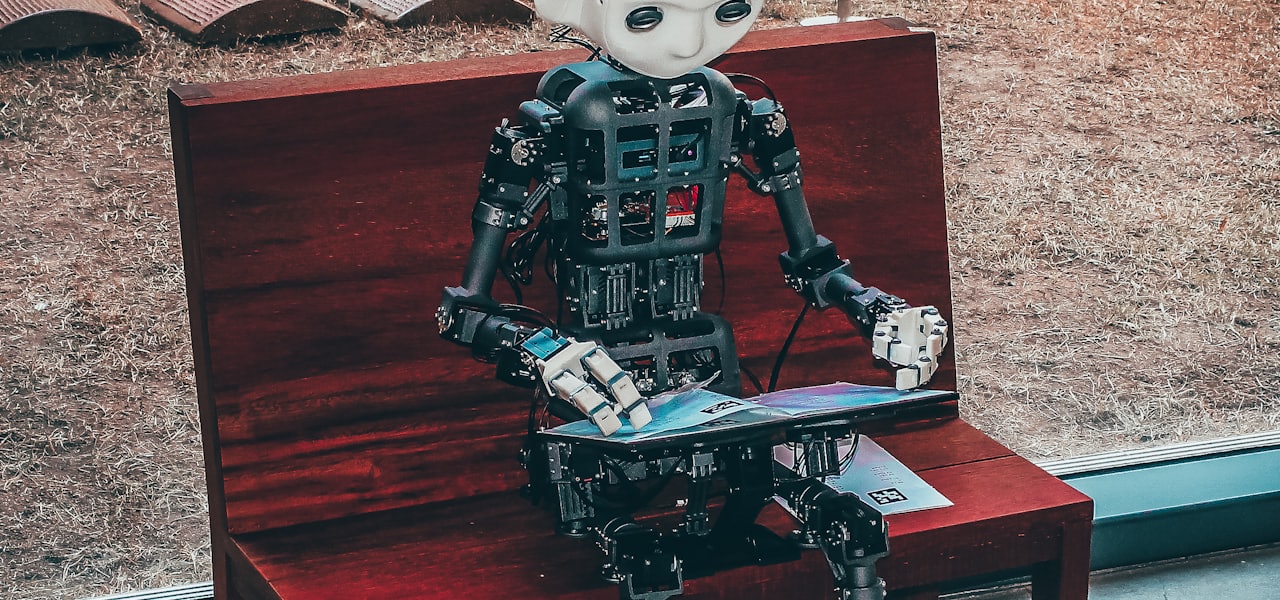
The following outline is provided as an overview of and topical guide to robotics: Robotics is a branch of mechanical engineering, electrical engineering and computer science that deals with the design, construction, operation, and application of robots, as well as computer systems for their control, sensory feedback, and information processing. These technologies deal with automated machines that can take the place of humans in dangerous environments or manufacturing processes, or resemble humans in appearance, behaviour, and or cognition. Many of today's robots are inspired by nature contributing to the field of bio-inspired robotics. The word "robot" was introduced to the public by Czech writer Karel Čapek in his play R.U.R. (Rossum's Universal Robots), published in 1920. The term "robotics" was coined by Isaac Asimov in his 1941 science fiction short-story "Liar!" == Nature of robotics == Robotics can be described as: An applied science – scientific knowledge transferred into a physical environment. A branch of computer science – A branch of electrical engineering – A branch of mechanical engineering – Research and development – A branch of technology – == Branches of robotics == Adaptive control – control method used by a controller which must adapt to a controlled system with parameters which vary, or are initially uncertain. For example, as an aircraft flies, its mass will slowly decrease as a result of fuel consumption; a control law is needed that adapts itself to such changing conditions. Aerial robotics – development of unmanned aerial vehicles (UAVs), commonly known as drones, aircraft without a human pilot aboard. Their flight is controlled either autonomously by onboard computers or by the remote control of a pilot on the ground or in another vehicle. Android science – interdisciplinary framework for studying human interaction and cognition based on the premise that a very humanlike robot (that is, an android) can elicit human-directed social responses in human beings. Anthrobotics – science of developing and studying robots that are either entirely or in some way human-like. Artificial intelligence – the intelligence of machines and the branch of computer science that aims to create it. Artificial neural networks – a mathematical model inspired by biological neural networks. Autonomous car – an autonomous vehicle capable of fulfilling the human transportation capabilities of a traditional car Autonomous research robotics – Bayesian network – BEAM robotics – a style of robotics that primarily uses simple analogue circuits instead of a microprocessor in order to produce an unusually simple design (in comparison to traditional mobile robots) that trades flexibility for robustness and efficiency in performing the task for which it was designed. Behavior-based robotics – the branch of robotics that incorporates modular or behavior based AI (BBAI). Bio-inspired robotics – making robots that are inspired by biological systems. Biomimicry and bio-inspired design are sometimes confused. Biomimicry is copying the nature while bio-inspired design is learning from nature and making a mechanism that is simpler and more effective than the system observed in nature. Biomimetic – see Bionics. Biomorphic robotics – a sub-discipline of robotics focused upon emulating the mechanics, sensor systems, computing structures and methodologies used by animals. Bionics – also known as biomimetics, biognosis, biomimicry, or bionical creativity engineering is the application of biological methods and systems found in nature to the study and design of engineering systems and modern technology. Biorobotics – a study of how to make robots that emulate or simulate living biological organisms mechanically or even chemically. Cloud robotics – is a field of robotics that attempts to invoke cloud technologies such as cloud computing, cloud storage, and other Internet technologies centered around the benefits of converged infrastructure and shared services for robotics. Cognitive robotics – views animal cognition as a starting point for the development of robotic information processing, as opposed to more traditional Artificial Intelligence techniques. Clustering – Computational neuroscience – study of brain function in terms of the information processing properties of the structures that make up the nervous system. Robot control – a study of controlling robots Robotics conventions – Data mining Techniques – Degrees of freedom – in mechanics, the degree of freedom (DOF) of a mechanical system is the number of independent parameters that define its configuration. It is the number of parameters that determine the state of a physical system and is important to the analysis of systems of bodies in mechanical engineering, aeronautical engineering, robotics, and structural engineering. Developmental robotics – a methodology that uses metaphors from neural development and developmental psychology to develop the mind for autonomous robots Digital control – a branch of control theory that uses digital computers to act as system controllers. Digital image processing – the use of computer algorithms to perform image processing on digital images. Dimensionality reduction – the process of reducing the number of random variables under consideration, and can be divided into feature selection and feature extraction. Distributed robotics – Electronic stability control – is a computerized technology that improves the safety of a vehicle's stability by detecting and reducing loss of traction (skidding). Evolutionary computation – Evolutionary robotics – a methodology that uses evolutionary computation to develop controllers for autonomous robots Extended Kalman filter – Flexible Distribution functions – Feedback control and regulation – Human–computer interaction – a study, planning and design of the interaction between people (users) and computers Human robot interaction – a study of interactions between humans and robots Intelligent vehicle technologies – comprise electronic, electromechanical, and electromagnetic devices - usually silicon micromachined components operating in conjunction with computer controlled devices and radio transceivers to provide precision repeatability functions (such as in robotics artificial intelligence systems) emergency warning validation performance reconstruction. Computer vision – Machine vision – Kinematics – study of motion, as applied to robots. This includes both the design of linkages to perform motion, their power, control and stability; also their planning, such as choosing a sequence of movements to achieve a broader task. Laboratory robotics – the act of using robots in biology or chemistry labs Robot learning – learning to perform tasks such as obstacle avoidance, control and various other motion-related tasks Direct manipulation interface – In computer science, direct manipulation is a human–computer interaction style which involves continuous representation of objects of interest and rapid, reversible, and incremental actions and feedback. The intention is to allow a user to directly manipulate objects presented to them, using actions that correspond at least loosely to the physical world. Manifold learning – Microrobotics – a field of miniature robotics, in particular mobile robots with characteristic dimensions less than 1 mm Motion planning – (a.k.a., the "navigation problem", the "piano mover's problem") is a term used in robotics for the process of detailing a task into discrete motions. Motor control – information processing related activities carried out by the central nervous system that organize the musculoskeletal system to create coordinated movements and skilled actions. Nanorobotics – the emerging technology field creating machines or robots whose components are at or close to the scale of a nanometer (10−9 meters). Passive dynamics – refers to the dynamical behavior of actuators, robots, or organisms when not drawing energy from a supply (e.g., batteries, fuel, ATP). Programming by Demonstration – an End-user development technique for teaching a computer or a robot new behaviors by demonstrating the task to transfer directly instead of programming it through machine commands. Quantum robotics – a subfield of robotics that deals with using quantum computers to run robotics algorithms more quickly than digital computers can. Rapid prototyping – automatic construction of physical objects via additive manufacturing from virtual models in computer aided design (CAD) software, transforming them into thin, virtual, horizontal cross-sections and then producing successive layers until the items are complete. As of June 2011, used for making models, prototype parts, and production-quality parts in relatively small numbers. Reinforcement learning – an area of machine learning in computer science, concerned with how an agent ought to take actions in an environment so as to maximize some notion of cumulative reward. Robot
Deep Instinct
Deep Instinct is a cybersecurity company that applies deep learning to cybersecurity. The company implements artificial intelligence to the task of preventing and detecting malware. The company was the recipient of the Technology Pioneer by The World Economic Forum in 2017. Lane Bess has been CEO of the company since 2022. == Overview == In 2015, Deep Instinct was founded by Guy Caspi, Dr. Eli David, and Nadav Maman. The headquarters of the company is located in New York City. In July 2017, NVIDIA became an investor. According to Tom's Hardware, NVIDIA’s investment enabled access to a GPU-based neural network and CUDA platform, which they were using to achieve maximum vulnerability detection rates. As of February 2020, the company had raised $43 million in Series C funding round. In April 2021, Deep Instinct raised $100 million in Series D funding to accelerate growth. == Partnerships == In April 2019, Deep Instinct partnered with Chinese artist, Guo O. Dong on an art project titled, The Persistence of Chaos, consisting of a laptop infected with 6 pieces of malware that represented $95 billion in damages. The art was auctioned with a final bid of $1,345,000. In the same year, Globes reported that, HP Inc partnered with Deep Instinct to launch their security solution HP SureSense, which has been applied to the EliteBook and Zbook devices.
Act! LLC
ACT! (previously known as Activity Control Technology, Automated Contact Tracking, ACT! by Sage, and Sage ACT!) is a customer relationship management and marketing automation software platform designed for small and medium-sized businesses. It has over 2.8 million registered users as of December 2014. == History == The company Conductor Software was founded in 1986, in Dallas, Texas, by Pat Sullivan and Mike Muhney. The original name for the software was Activity Control Technology; it was renamed to Automated Contact Tracking, later abbreviated to ACT. The name of the company was subsequently changed to Contact Software International and it was sold in 1993 to Symantec Corporation, who in 1999 then sold it to SalesLogix. The Sage Group purchased Interact Commerce (formerly SalesLogix) in 2001 through Best Software, then its North American software division. Swiftpage acquired it in 2013. Beginning with the 2006 version, the name was styled ACT! by Sage, and in 2010 revised to Sage ACT!. Following its 2013 acquisition by Swiftpage, it was renamed to ACT! Swiftpage. In May 2018, ACT! was sold to SFW Advisors. In December 2018, Kuvana, a marketing automation software solution, was acquired by SFW and merged with ACT! This add-on is now a complementary service to the core CRM solution. In December 2019, ACT! hired Steve Oriola as chairman and CEO. In 2020, Swiftpage changed its company name to ACT!. In March 2023, ACT! hired Bruce Reading as President and CEO. == Software == ACT! features include contact, company and opportunity management, a calendar, marketing automation and e-marketing tools, reports, interactive dashboards with graphical visualizations, and the ability to track prospective customers. ACT! integrates with Microsoft Word, Excel, Outlook, Google Contacts, Gmail, and other applications via Zapier. For custom integrations, ACT! has an in-built API. ACT! can be accessed from Windows desktops (Win7 and later) with local or network shared database; synchronized to laptops or remote officers; Citrix or Remote Desktop; Web browsers (Premium only) with self or SaaS hosting; smartphones and tablets via HTML5 Web (Premium only); smartphones and tablets via sync with Handheld Contact.