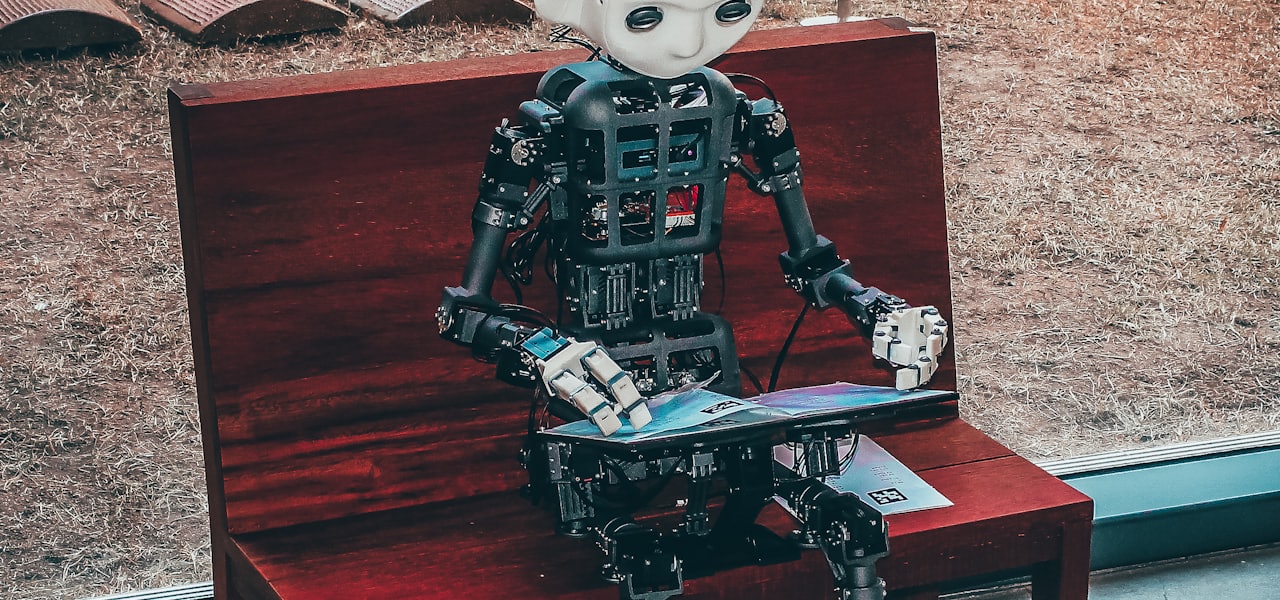
Cybernetics is the transdisciplinary study of circular causal processes such as feedback and recursion, where the effects of a system's actions (its outputs) return as inputs to that system, influencing subsequent actions. It is concerned with general principles that are relevant across multiple contexts, including engineering, ecological, economic, biological, cognitive and social systems and also in practical activities such as designing, learning, and managing. Cybernetics' transdisciplinary character means that it intersects with a number of other fields, resulting in a wide influence and diverse interpretations. The field is named after an example of circular causal feedback—that of steering a ship (the ancient Greek κυβερνήτης (kybernḗtēs) refers to the person who steers a ship). In steering a ship, the position of the rudder is adjusted in continual response to the effect it is observed as having, forming a feedback loop through which a steady course can be maintained in a changing environment, responding to disturbances from cross winds and tide. Cybernetics has its origins in exchanges between numerous disciplines during the 1940s. Initial developments were consolidated through meetings such as the Macy conferences and the Ratio Club. Early focuses included purposeful behaviour, neural networks, heterarchy, information theory, and self-organising systems. As cybernetics developed, it became broader in scope to include work in design, family therapy, management and organisation, pedagogy, sociology, the creative arts and the counterculture. == Definitions == Cybernetics has been defined in a variety of ways, reflecting "the richness of its conceptual base". One of the best known definitions is that of the American scientist Norbert Wiener, who characterised cybernetics as concerned with "control and communication in the animal and the machine". Another early definition is that of the Macy cybernetics conferences, where cybernetics was understood as the study of "circular causal and feedback mechanisms in biological and social systems". Margaret Mead emphasised the role of cybernetics as "a form of cross-disciplinary thought which made it possible for members of many disciplines to communicate with each other easily in a language which all could understand". Other definitions include: "the art of governing or the science of government" (André-Marie Ampère); "the art of steersmanship" (Ross Ashby); "the study of systems of any nature which are capable of receiving, storing, and processing information so as to use it for control" (Andrey Kolmogorov); and "a branch of mathematics dealing with problems of control, recursiveness, and information, focuses on forms and the patterns that connect" (Gregory Bateson). == Etymology == The Ancient Greek term κυβερνητικός (kubernētikos, '(good at) steering') appears in Plato's Republic and Alcibiades, where the metaphor of a steersman is used to signify the governance of people. The French word cybernétique was also used in 1834 by the physicist André-Marie Ampère to denote the sciences of government in his classification system of human knowledge. According to Norbert Wiener, the word cybernetics was coined by a research group involving himself and Arturo Rosenblueth in the summer of 1947. It has been attested in print since at least 1948 through Wiener's book Cybernetics: Or Control and Communication in the Animal and the Machine. In the book, Wiener states: After much consideration, we have come to the conclusion that all the existing terminology has too heavy a bias to one side or another to serve the future development of the field as well as it should; and as happens so often to scientists, we have been forced to coin at least one artificial neo-Greek expression to fill the gap. We have decided to call the entire field of control and communication theory, whether in the machine or in the animal, by the name Cybernetics, which we form from the Greek κυβερνήτης or steersman. Moreover, Wiener explains, the term was chosen to recognize James Clerk Maxwell's 1868 publication on feedback mechanisms involving governors, noting that the term governor is also derived from κυβερνήτης (kubernḗtēs) via a Latin corruption gubernator. Finally, Wiener motivates the choice by steering engines of a ship being "one of the earliest and best-developed forms of feedback mechanisms". == History == === First wave === The initial focus of cybernetics was on parallels between regulatory feedback processes in biological and technological systems. Two foundational articles were published in 1943: "Behavior, Purpose and Teleology" by Arturo Rosenblueth, Norbert Wiener, and Julian Bigelow – based on the research on living organisms that Rosenblueth did in Mexico – and the paper "A Logical Calculus of the Ideas Immanent in Nervous Activity" by Warren McCulloch and Walter Pitts. The foundations of cybernetics were then developed through a series of transdisciplinary conferences funded by the Josiah Macy, Jr. Foundation, between 1946 and 1953. The conferences were chaired by McCulloch and had participants that included Ross Ashby, Gregory Bateson, Heinz von Foerster, Margaret Mead, John von Neumann, and Norbert Wiener. In the UK, similar focuses were explored by the Ratio Club, an informal dining club of young psychiatrists, psychologists, physiologists, mathematicians and engineers that met between 1949 and 1958. Wiener introduced the neologism cybernetics to denote the study of "teleological mechanisms" and popularized it through the book Cybernetics: Or Control and Communication in the Animal and the Machine. During the 1950s, cybernetics was developed as a primarily technical discipline, such as in Qian Xuesen's 1954 "Engineering Cybernetics". The text was quickly translated into multiple languages and became a foundational text on automation. In the Soviet Union, Cybernetics was initially considered with suspicion but became accepted from the mid to late 1950s. By the 1960s and 1970s, however, cybernetics' transdisciplinarity fragmented, with technical focuses separating into separate fields. Artificial intelligence (AI) was founded as a distinct discipline at the Dartmouth workshop in 1956, differentiating itself from the broader cybernetics field. After some uneasy coexistence, AI gained funding and prominence. Consequently, cybernetic sciences such as the study of artificial neural networks were downplayed. Similarly, computer science became defined as a distinct academic discipline in the 1950s and early 1960s. === Second wave === The second wave of cybernetics came to prominence from the 1960s onwards, with its focus shifting away from technology toward social, ecological, and philosophical concerns. It was still grounded in biology, notably Maturana and Varela's autopoiesis, and built on earlier work on self-organising systems and the presence of anthropologists Mead and Bateson in the Macy meetings. The Biological Computer Laboratory, founded in 1958 and active until the mid-1970s under the direction of Heinz von Foerster at the University of Illinois at Urbana–Champaign, was a major incubator of this trend in cybernetics research. Focuses of the second wave of cybernetics included management cybernetics, such as Stafford Beer's biologically inspired viable system model; work in family therapy, drawing on Bateson; social systems, such as in the work of Niklas Luhmann; epistemology and pedagogy, such as in the development of radical constructivism. Cybernetics' core theme of circular causality was developed beyond goal-oriented processes to concerns with reflexivity and recursion, notably in Mead's invocation at the inaugural meeting of the American Society for Cybernetics (ASC) to apply cybernetics to the activities of the ASC itself. This focus on reflexivity was especially prominent in the development of second-order cybernetics (or the cybernetics of cybernetics), developed and promoted by Heinz von Foerster, which focused on questions of observation, cognition, epistemology, and ethics. The 1960s onwards also saw cybernetics begin to develop exchanges with the creative arts, design, and architecture, notably with the Cybernetic Serendipity exhibition (ICA, London, 1968), curated by Jasia Reichardt, and the unrealised Fun Palace project (London, unrealised, 1964 onwards), where Gordon Pask was consultant to architect Cedric Price and theatre director Joan Littlewood. In 1962, Qian Xuesen recruited Song Jian and Guan Zhaozhi to establish China's first cybernetics laboratory with him. Following the Sino-Soviet split, cybernetics was deemed disreputable in China. The field was again favored in the 1970s and 1980s following Deng Xiaoping's emphasis on modernisation. === Third wave === From the 1990s onwards, there has been a renewed interest in cybernetics from a number of directions. Early cybernetic work on artificial neural networks has been returned to as a paradigm in machine learning and artifi
Cloud-computing comparison
The following is a comparison of cloud-computing software and providers. == IaaS (Infrastructure as a service) == === Providers === ==== General ==== == SaaS (Software as a Service) == === General === === Supported hosts === === Supported guests === == PaaS (Platform as a service) == === Providers === === Providers on IaaS === PaaS providers which can run on IaaS providers ("itself" means the provider is both PaaS and IaaS):
Xuedong Huang
Xuedong David Huang (born October 20, 1962) is a Chinese-American computer scientist and technology executive who has made contributions to spoken language processing and artificial intelligence, including Azure AI Services. He is Zoom's chief technology officer after serving as Microsoft's Technical Fellow and Azure AI Chief Technology Officer for 30 years. Huang is a strong advocate of AI for Accessibility, and AI for Cultural Heritage. == Education == Huang received his PhD from the University of Edinburgh in 1989 (sponsored by the British ORS and Edinburgh University Scholarship), his MS from Tsinghua University in 1984, and BS from Hunan University in 1982. == Career == After receiving his PhD in 1989, Huang joined Carnegie Mellon University and worked with Raj Reddy and Kai-Fu Lee on speech recognition. At CMU, he directed the Sphinx-II speech system research which achieved the best performance in every category of DARPA's 1992 benchmarking. Microsoft Research recruited him to found and lead Microsoft's spoken language initiatives in 1993. His co-authored book Spoken Language Processing and his Historical speech recognition review succinctly summarize several generations of spoken language research. As Microsoft's Mr. Speech for three decades, Huang has been instrumental in creating Microsoft's Speech Application Programming Interface (SAPI), shipping Microsoft Speech Server, and modernizing spoken language and integrative AI services via Azure AI, which not only enables millions of 3rd party customers but also powers up Microsoft's Windows, Office, Teams, and Azure OpenAI Services. Huang helped Microsoft and Azure Cognitive Services achieve multiple industry's first human parity milestones on the following open research tasks: transcribing conversational speech, machine translation, conversational QnA, and computer vision image captioning. Huang has made significant contributions to the software and AI industry through his executive leadership and his scientific publications, owning more than 170 US patents and impacting billions through Azure AI enabled products and services. In 2016, Wired magazine named him one of 25 Geniuses. In 2021, Azure AI was named the winner of InfoWorld's Technology of the Year Award. Huang was awarded the Allen Newell research excellence medal in 1992, and IEEE Speech Processing Best Paper in 1993. He was recognized as an IEEE Fellow by Institute of Electrical and Electronics Engineers in 2000, named ACM Fellow by Association for Computing Machinery in 2017, and a member of Washington State Academy of Sciences. Huang received 2022 Asian American Corporate Leadership Award, and IEEE Amar Bose Industrial Leader Award. In 2023, he was elected a member of the US National Academy of Engineering (NAE), and a member of the American Academy of Arts and Sciences.
AI Code-review Tools Reviews: What Actually Works in 2026
Shopping for the best AI code-review tool? An AI code-review tool is software that uses machine learning to help you get more done — it keeps getting smarter as the underlying models improve. Pricing, accuracy, and the size of the model behind the tool are the three factors that most affect daily usefulness. Whether you are a beginner or a pro, the right AI code-review tool slots into your workflow and pays for itself fast. Below we compare features, pricing, and real output so you can choose with confidence.
Leslie P. Kaelbling
Leslie Pack Kaelbling is an American roboticist and the Panasonic Professor of Computer Science and Engineering at the Massachusetts Institute of Technology. She is widely recognized for adapting partially observable Markov decision processes from operations research for application in artificial intelligence and robotics. Kaelbling received the IJCAI Computers and Thought Award in 1997 for applying reinforcement learning to embedded control systems and developing programming tools for robot navigation. In 2000, she was elected as a Fellow of the Association for the Advancement of Artificial Intelligence. == Career == Kaelbling received an A. B. in Philosophy in 1983 and a Ph.D. in Computer Science in 1990, both from Stanford University. During this time she was also affiliated with the Center for the Study of Language and Information. She then worked at SRI International and the affiliated robotics spin-off Teleos Research before joining the faculty at Brown University. She left Brown in 1999 to join the faculty at MIT. Her research focuses on decision-making under uncertainty, machine learning, and sensing with applications to robotics. == Journal of Machine Learning Research == In the spring of 2000, she and two-thirds of the editorial board of the Kluwer-owned journal Machine Learning resigned in protest to its pay-to-access archives with simultaneously limited financial compensation for authors. Kaelbling co-founded and served as the first editor-in-chief of the Journal of Machine Learning Research, a peer-reviewed open access journal on the same topics which allows researchers to publish articles for free and retain copyright with its archives freely available online. In response to the mass resignation, Kluwer changed their publishing policy to allow authors to self-archive their papers online after peer-review. Kaelbling responded that this policy was reasonable and would have made the creation of an alternative journal unnecessary, but the editorial board members had made it clear they wanted such a policy and it was only after the threat of resignations and the actual founding of JMLR that the publishing policy finally changed. == Selected works == Reinforcement Learning: A Survey (LP Kaelbling, ML Littman, AW Moore). Journal of Artificial Intelligence Research (JAIR) 4 (1996) 237-285. A highly cited survey on the field of reinforcement learning. Planning and acting in partially observable stochastic domains (LP Kaelbling, ML Littman, AR Cassandra). Artificial Intelligence 101 (1), 99-134. Acting under uncertainty: Discrete Bayesian models for mobile-robot navigation (AR Cassandra, LP Kaelbling, JA Kurien). Intelligent Robots and Systems (2) 963-972. The synthesis of digital machines with provable epistemic properties (SJ Rosenschein, LP Kaelbling). Proceedings of the 1986 Conference on Theoretical Aspects of Reasoning about Knowledge, 83-98. Practical reinforcement learning in continuous spaces (WD Smart, LP Kaelbling). 2000 International Conference on Machine Learning (ICML), 903-910. Hierarchical task and motion planning in the now (LP Kaelbling, T Lozano-Pérez). 2011 IEEE International Conference on Robotics and Automation (ICRA), 1470-1477.
Template matching
Template matching is a technique in digital image processing for finding small parts of an image which match a template image. It can be used for quality control in manufacturing, navigation of mobile robots, or edge detection in images. The main challenges in a template matching task are detection of occlusion, when a sought-after object is partly hidden in an image; detection of non-rigid transformations, when an object is distorted or imaged from different angles; sensitivity to illumination and background changes; background clutter; and scale changes. == Feature-based approach == The feature-based approach to template matching relies on the extraction of image features, such as shapes, textures, and colors, that match the target image or frame. This approach is usually achieved using neural networks and deep-learning classifiers such as VGG, AlexNet, and ResNet.Convolutional neural networks (CNNs), which many modern classifiers are based on, process an image by passing it through different hidden layers, producing a vector at each layer with classification information about the image. These vectors are extracted from the network and used as the features of the image. Feature extraction using deep neural networks, like CNNs, has proven extremely effective has become the standard in state-of-the-art template matching algorithms. This feature-based approach is often more robust than the template-based approach described below. As such, it has become the state-of-the-art method for template matching, as it can match templates with non-rigid and out-of-plane transformations, as well as high background clutter and illumination changes. == Template-based approach == For templates without strong features, or for when the bulk of a template image constitutes the matching image as a whole, a template-based approach may be effective. Since template-based matching may require sampling of a large number of data points, it is often desirable to reduce the number of sampling points by reducing the resolution of search and template images by the same factor before performing the operation on the resultant downsized images. This pre-processing method creates a multi-scale, or pyramid, representation of images, providing a reduced search window of data points within a search image so that the template does not have to be compared with every viable data point. Pyramid representations are a method of dimensionality reduction, a common aim of machine learning on data sets that suffer the curse of dimensionality. == Common challenges == In instances where the template may not provide a direct match, it may be useful to implement eigenspaces to create templates that detail the matching object under a number of different conditions, such as varying perspectives, illuminations, color contrasts, or object poses. For example, if an algorithm is looking for a face, its template eigenspaces may consist of images (i.e., templates) of faces in different positions to the camera, in different lighting conditions, or with different expressions (i.e., poses). It is also possible for a matching image to be obscured or occluded by an object. In these cases, it is unreasonable to provide a multitude of templates to cover each possible occlusion. For example, the search object may be a playing card, and in some of the search images, the card is obscured by the fingers of someone holding the card, or by another card on top of it, or by some other object in front of the camera. In cases where the object is malleable or poseable, motion becomes an additional problem, and problems involving both motion and occlusion become ambiguous. In these cases, one possible solution is to divide the template image into multiple sub-images and perform matching on each subdivision. == Deformable templates in computational anatomy == Template matching is a central tool in computational anatomy (CA). In this field, a deformable template model is used to model the space of human anatomies and their orbits under the group of diffeomorphisms, functions which smoothly deform an object. Template matching arises as an approach to finding the unknown diffeomorphism that acts on a template image to match the target image. Template matching algorithms in CA have come to be called large deformation diffeomorphic metric mappings (LDDMMs). Currently, there are LDDMM template matching algorithms for matching anatomical landmark points, curves, surfaces, volumes. == Template-based matching explained using cross correlation or sum of absolute differences == A basic method of template matching sometimes called "Linear Spatial Filtering" uses an image patch (i.e., the "template image" or "filter mask") tailored to a specific feature of search images to detect. This technique can be easily performed on grey images or edge images, where the additional variable of color is either not present or not relevant. Cross correlation techniques compare the similarities of the search and template images. Their outputs should be highest at places where the image structure matches the template structure, i.e., where large search image values get multiplied by large template image values. This method is normally implemented by first picking out a part of a search image to use as a template. Let S ( x , y ) {\displaystyle S(x,y)} represent the value of a search image pixel, where ( x , y ) {\displaystyle (x,y)} represents the coordinates of the pixel in the search image. For simplicity, assume pixel values are scalar, as in a greyscale image. Similarly, let T ( x t , y t ) {\textstyle T(x_{t},y_{t})} represent the value of a template pixel, where ( x t , y t ) {\textstyle (x_{t},y_{t})} represents the coordinates of the pixel in the template image. To apply the filter, simply move the center (or origin) of the template image over each point in the search image and calculate the sum of products, similar to a dot product, between the pixel values in the search and template images over the whole area spanned by the template. More formally, if ( 0 , 0 ) {\displaystyle (0,0)} is the center (or origin) of the template image, then the cross correlation T ⋆ S {\displaystyle T\star S} at each point ( x , y ) {\displaystyle (x,y)} in the search image can be computed as: ( T ⋆ S ) ( x , y ) = ∑ ( x t , y t ) ∈ T T ( x t , y t ) ⋅ S ( x t + x , y t + y ) {\displaystyle (T\star S)(x,y)=\sum _{(x_{t},y_{t})\in T}T(x_{t},y_{t})\cdot S(x_{t}+x,y_{t}+y)} For convenience, T {\displaystyle T} denotes both the pixel values of the template image as well as its domain, the bounds of the template. Note that all possible positions of the template with respect to the search image are considered. Since cross correlation values are greatest when the values of the search and template pixels align, the best matching position ( x m , y m ) {\displaystyle (x_{m},y_{m})} corresponds to the maximum value of T ⋆ S {\displaystyle T\star S} over S {\displaystyle S} . Another way to handle translation problems on images using template matching is to compare the intensities of the pixels, using the sum of absolute differences (SAD) measure. To formulate this, let I S ( x s , y s ) {\displaystyle I_{S}(x_{s},y_{s})} and I T ( x t , y t ) {\displaystyle I_{T}(x_{t},y_{t})} denote the light intensity of pixels in the search and template images with coordinates ( x s , y s ) {\displaystyle (x_{s},y_{s})} and ( x t , y t ) {\displaystyle (x_{t},y_{t})} , respectively. Then by moving the center (or origin) of the template to a point ( x , y ) {\displaystyle (x,y)} in the search image, as before, the sum of absolute differences between the template and search pixel intensities at that point is: S A D ( x , y ) = ∑ ( x t , y t ) ∈ T | I T ( x t , y t ) − I S ( x t + x , y t + y ) | {\displaystyle SAD(x,y)=\sum _{(x_{t},y_{t})\in T}\left\vert I_{T}(x_{t},y_{t})-I_{S}(x_{t}+x,y_{t}+y)\right\vert } With this measure, the lowest SAD gives the best position for the template, rather than the greatest as with cross correlation. SAD tends to be relatively simple to implement and understand, but it also tends to be relatively slow to execute. A simple C++ implementation of SAD template matching is given below. == Implementation == In this simple implementation, it is assumed that the above described method is applied on grey images: This is why Grey is used as pixel intensity. The final position in this implementation gives the top left location for where the template image best matches the search image. One way to perform template matching on color images is to decompose the pixels into their color components and measure the quality of match between the color template and search image using the sum of the SAD computed for each color separately. == Speeding up the process == In the past, this type of spatial filtering was normally only used in dedicated hardware solutions because of the computational complexity of the operation, however we can lessen this complexity b
Is an Conversational AI Platform Worth It in 2026?
Looking for the best conversational AI platform? An conversational AI platform is software that uses machine learning to help you get more done — it can save you hours every week by automating repetitive work. Most options offer a generous free tier, with paid plans unlocking higher limits, faster processing, and team features. Whether you are a beginner or a pro, the right conversational AI platform slots into your workflow and pays for itself fast. This guide breaks down the top picks, their pros and cons, and who each one is best for.